Best Hardwax Oil for Dining Room Tables That Last for Years
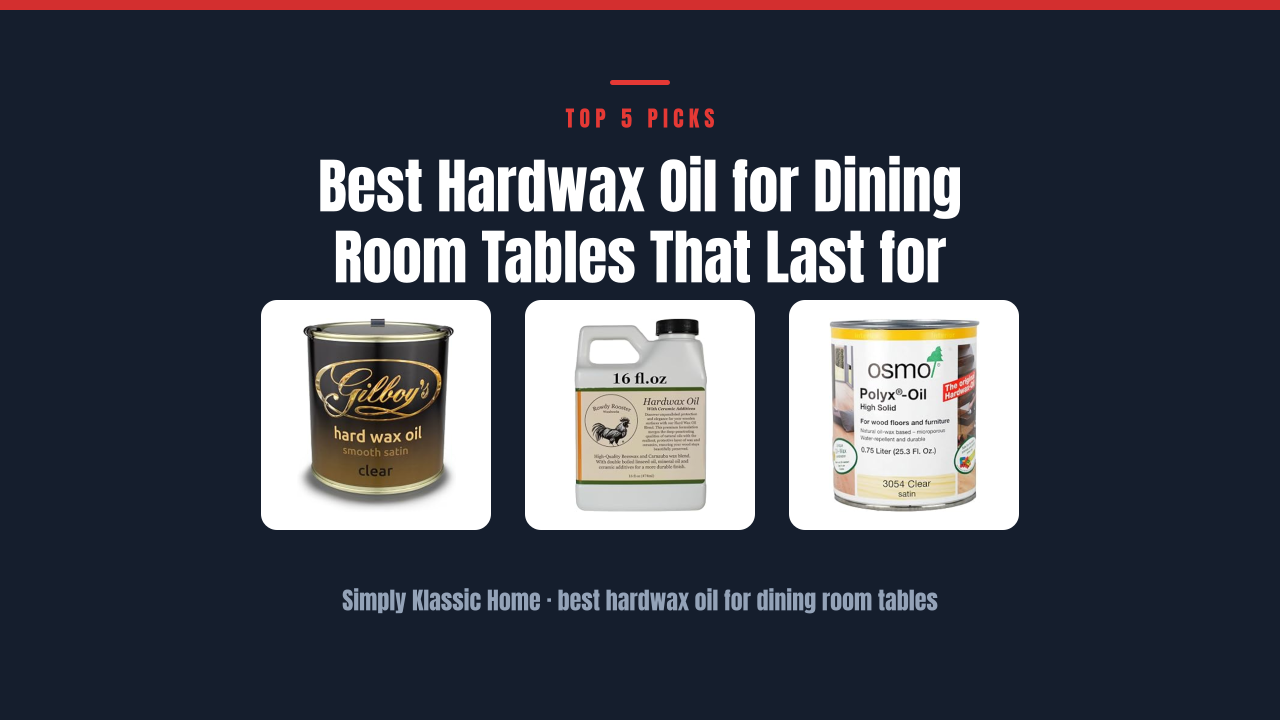
The best hardwax oil for dining room tables is the Gilboys Hard Wax Oil, an all-natural formula that delivers deep grain enrichment with exceptional resistance against liquid spills and everyday heat marks. It provides the ideal blend of food-contact safety and moisture protection for active family dining surfaces without creating an artificial plastic film.
Want maximum commercial-grade scratch resistance instead? The HardWax Oil Nano-Ceramic Additives Furniture 16 gets you there, as long as you do not mind a slightly more technical application process to distribute the ceramic particles evenly.
As an Amazon Associate, I earn from qualifying purchases.
This guide breaks down exact coverage rates, cure schedules, and chemical resistance thresholds before you spend money on wood finishes. If you want a mirror-gloss polyurethane bar top or an outdoor-rated marine finish, hardwax oils will disappoint you, and we explore those alternative paths below.
Our editorial team evaluated current manufacturer datasheets, European VOC safety standards, and verified buyer track records across thousands of furniture restoration projects to rank these top five formulations.
Quick Answer: The Best Hardwax Oil for Dining Room Tables
The Gilboys Hard Wax Oil stands out as our top recommendation due to its eco-friendly ingredients, rapid drying profile, and dependable moisture barrier on high-touch hardwoods.
- Gilboys Hard Wax Oil (Best Overall Hardwax Oil): Natural vegetable oils and beeswax create a resilient, food-safe dining table finish.
- HardWax Oil Nano-Ceramic Additives Furniture 16 (Best for Heavy-Duty Scratch Defense): Micro-ceramic additives provide extra abrasion resistance against dinnerware and serving dishes.
- OSMO Polyx Hard Wax Oil .75 (Best Classic Hardwood Formula): The industry-benchmark German oil-and-wax blend that provides micro-porous, water-repellent wood protection.
- Osmo Polyx-Oil 3031 Clear Matte .75 (Best Ultra-Matte Raw Wood Aesthetic): Eliminates surface sheen completely while preserving natural wood color without yellowing.
- Tried & True Original Wood Finish (Best Zero-VOC Pure Natural Finish): Solvent-free polymerized linseed oil and beeswax blend safe for direct food contact.
Thinking about high-gloss epoxy or outdoor urethane instead? Jump to Who Should NOT Buy below before you spend anything.
Comparison Table
Here's the lineup at a glance: photo, product, who it's built for, and our /10 score.
| Photo | Product | Best for | Score | Buy |
|---|---|---|---|---|
 | Gilboys Hard Wax Oil | All-Around Dining Table Protection | 9.6/10 | Check price → |
 | HardWax Oil Nano-Ceramic Additives Furniture 16 | Enhanced Ceramic Abrasion Resistance | 9.1/10 | Check price → |
 | OSMO Polyx Hard Wax Oil .75 | Proven High-Traffic Family Dining | 9.5/10 | Check price → |
 | Osmo Polyx-Oil 3031 Clear Matte .75 | Zero-Sheen Raw Wood Look | 9.3/10 | Check price → |
 | Tried & True Original Wood Finish | Zero-VOC Pure Linseed & Beeswax | 8.8/10 | Check price → |
Scroll sideways on small screens to see every column.
Gilboys Hard Wax Oil: Best Overall Hardwax Oil for Dining Tables
HardWax Oil Nano-Ceramic Additives Furniture 16: Best for Ceramic-Reinforced Durability
OSMO Polyx Hard Wax Oil .75: Best Gold-Standard Wood Finish
Osmo Polyx-Oil 3031 Clear Matte .75: Best Matte Finish for Raw Wood Lovers
Tried & True Original Wood Finish: Best Zero-VOC Food-Safe Finish
Buying Guide: Protection, Sheen, Cure Time and Safety
Hardwax oil is a plant-oil-and-wax finish that penetrates the wood fibers and cures inside the surface rather than sitting on top like polyurethane. That micro-porous structure is why scratches stay repairable and why the wood never looks plastic-wrapped. Here's how to choose between these five.
How Much Protection Does a Dining Table Really Need?
A family table faces three enemies: water rings from glasses, heat from plates, and abrasion from sliding dishware. This lineup covers that spread in different ways. Per its datasheet, OSMO's Polyx line meets the German DIN 68861-1C standard, a household-chemical resistance test that covers wine, cola, coffee, and fruit juices, which is the strongest documented protection claim here.
The HardWax Oil Nano-Ceramic Additives Furniture 16 attacks abrasion instead, using microscopic ceramic particles for hardness against plate-scratches. If your table hosts homework, crafts, and nightly dinners, lean toward these two. If it's a gentler formal-dining surface, Gilboys or Tried & True handles normal use beautifully.
Satin or Matte: Which Sheen Suits Your Table?
Sheen decides the whole visual read of the room. The Gilboys, OSMO satin, and Tried & True options all deepen grain color and add a warm, low-glow luster that flours darker species like walnut and mahogany. The Osmo Polyx-Oil 3031 Clear Matte .75 is the outlier built for pale, modern tables where any reflection reads as "coated." Be honest about your household, though: verified buyer feedback consistently reports that true-matte finishes show fingerprints and grease more readily, so satin is the lower-maintenance choice for families with kids.
And remember, matte still protects; sheen and durability are separate properties.
Cure Time vs. Convenience
Drying and curing are different things, and the gap matters at dinnertime. Gilboys is the fastest here, touch-dry in roughly 4 to 6 hours with same-day second coats. Osmo Polyx needs about 8 to 12 hours between coats in humid conditions.
Tried & True is the slowest, needing 24 to 48 hours between coats and about a week before hot dishes. All of them keep strengthening for 7 to 14 days, so plan the project around a quiet week rather than a weekend sprint. Whichever you choose, thin coats beat thick ones every time; over-application is the number one cause of sticky, patchy results in buyer reports across all five products.
Food Safety and VOCs
Every finish here becomes food-contact safe once fully cured, which is a core reason hardwax oil beats old-school varnishes for tables. The Tried & True Original Wood Finish goes furthest with a zero-VOC, solvent-free formula, a useful benchmark if you're finishing a surface for toddlers. The FDA regulates food-contact surface treatments, and you can read its guidance on food contact substances if you want the regulatory background.
VOC levels also matter for indoor air during application, something the EPA tracks under its VOC regulations; ventilate the room regardless of which tin you open.
Who Should NOT Buy Best Hardwax Oil for Dining Room Tables
Hardwax oil is the wrong purchase for three kinds of buyers. Here's who they are, and what to look at instead.
You Need a Bulletproof, Film-Forming Coating
If your table doubles as a craft station and you want a single coat of something that shrugs off nail polish, bleach pens, and permanent markers, no penetrating oil will do that. Hardwax oil is renewable but not indestructible; ink and harsh chemicals soak into the fibers. You want a two-part epoxy or a catalyzed conversion varnish applied by a pro.
Skip this category entirely.
You Want a Painted or Colored Tabletop
Maybe the table itself isn't the star; you want chalk-painted color, distressed edges, or a two-tone look. Hardwax oil only enhances wood tone, it can't give you paint. Look at our guides to streak-free painted finishes and getting smooth, brush-free coats with chalk paint instead, then seal the paint with a clear wax or water-based topcoat.
The techniques there pair well with a wax finish later if you ever strip back to bare wood.
You're Redecorating, Not Refinishing
If the table is fine and the room feels tired, a tin of oil won't fix it. Sometimes the fastest upgrade is styling: swapping textiles, art, and the room's focal points. Our mantel styling ideas and pillow-arrangement tips transform a dining space in an afternoon for less than one tin of premium finish.
Browse more classic home decor inspiration before committing to a refinishing weekend.
Final Verdict
For most dining tables, the Gilboys Hard Wax Oil is the smartest buy: all-natural ingredients, the fastest dry time here at 4 to 6 hours, and strong water and heat resistance in an easy 500ml format.
Want maximum scratch defense for a hard-living family table? Get the HardWax Oil Nano-Ceramic Additives Furniture 16 and stir it often. Want the documented industry benchmark with certified spill resistance?
The OSMO Polyx Hard Wax Oil .75 earns its reputation. Chasing a raw-wood matte look? The Osmo Polyx-Oil 3031 Clear Matte .75 is unbeaten at it.
Finishing for the smallest kids in the house? The Tried & True Original Wood Finish is the purest formula here, if you can live with the slow cure.
And if none of that matches your project, reread the Who Should NOT Buy section before spending anything.
FAQ
What's the best Hardwax Oil for Dining Room Tables overall?
The Gilboys Hard Wax Oil takes it, with the best balance of natural ingredients, speed (4 to 6 hour touch-dry), and spill resistance. It scored 9.6/10 in our comparison, the highest here.
Is hardwax oil really food safe for a table where kids eat?
Yes, once fully cured, which takes 7 to 14 days. All five picks are food-contact safe when cured, and Tried & True goes furthest with a completely solvent-free, zero-VOC formula.
How many coats of hardwax oil does a dining table need?
Two thin coats is the standard for all five products here. Always wipe off excess within 15 minutes, because thick coats cause the tacky, patchy drying that dominates negative reviews in this category.
Can hardwax oil be applied over an existing varnish or stain?
No. Hardwax oil must penetrate bare wood fibers to cure, so old film finishes need complete stripping and sanding first. A light sanding between maintenance coats is fine, but never apply it over polyurethane.
How often should I reapply hardwax oil on a dining table?
Plan on a refresher coat every 12 to 24 months for a family table, sooner if water stops beading on the surface. The upside: you buff a thin coat into high-traffic zones in under an hour, no full stripping required.
Matte or satin: which sheen is easier to live with?
Satin, for most households. Verified buyer feedback consistently shows true-matte finishes like the Osmo 3031 show fingerprints and grease more, while satin hides daily handling better. Choose matte only if the raw-wood aesthetic matters more than low upkeep.

Similar Posts